
ERP Implementation guide
Phases, Challenges and Best Practices for Successful Projects
An enterprise resource planning (ERP) implementation can radically improve the way an organization functions. However, replacing an existing system with an ERP solution involves significantly more tasks than just installing and deploying new software.
An ERP implementation impacts processes, data, integrations, responsibilities, and the daily work of employees across the organization. It needs business and IT teams to collaborate, make decisions under pressure, manage dependencies, and prepare employees for new ways of working.
So even if you pick the right ERP software for your business, your ERP implementation project can still go wrong.
What does a successful ERP implementation project actually require?
The answer begins with understanding the implementation process, the key risks, and what it takes to be able to manage risk.
What is an ERP implementation?
An enterprise resource planning system implementation is the process of deploying an ERP system company-wide to enable core business processes. An ERP system integrates finance, procurement, sales, supply chain management, manufacturing, human resources, and other functions into a single common software environment.
However, an ERP implementation is not just an IT project.
It can involve:
-
Business-process analysis and redesign
-
ERP software configuration
-
Data cleansing and ERP migration
-
Enterprise resource planning integration
-
Interfaces with other applications
-
Testing and defect resolution
-
Organizational and role changes
-
User training
-
Change management
-
Cutover and go-live preparation
-
Post-go-live support and optimization
A successful implementation project needs to have both organizational and technical capacity.
Previous studies of ERP implementation success also found that project management, top-management support, training, communication of change management, business-process alignment, data management, and teamwork were significant factors for successful implementation.
Why do ERP implementations become challenging?
ERP implementations involve many interlinked and dependent activities. If something is happening in one part of it, it can immediately cause a problem somewhere else.
Several examples can suggest this complexity: Missing or ambiguous business requirements can result in an incorrect configuration of the system. Incomplete or inaccurate data can result in poor testing. Decisional delays result in poor development and integration. Lack of user participation results in processes that run but do not fit operationally.
Common ERP implementation challenges include:
-
Unclear objectives and scope
-
Lack of senior management support
-
Poor project management
-
Insufficient implementation skills
-
Weak cooperation between business and IT
-
Poor data quality and migration problems
-
Inadequate user involvement
-
Insufficient training
-
Communication barriers
-
Integration complexity
-
Excessive customization
-
Unrealistic schedules
-
Weak testing
-
Poor preparation for go-live
-
Insufficient post-go-live support
A systematic review of ERP implementations pinpointed 31 key issues. The key areas of concern are top management support, change management, training and development for end users, communication of project progress, system and data integration, business process re-engineering, selection of consultants and vendors, project management, and project team composition.
The key point is that these challenges are not isolated; they are interrelated. The linkage can be revealed and discovered with deep software implementation knowledge.
Benefits of a successful ERP implementation
Organizations implement ERP systems because they expect positive business benefits and outcomes.
When properly and effectively implemented, an ERP system can support:
Centralized data and improved visibility
ERP systems can integrate information from several departments or functions across a company into a single system. Such integration can minimize the need for separate systems and spreadsheets and provide a more unified view of information for decision-makers.
More efficient business processes
Once you start to implement an ERP, that is a good time to look at how work is currently being performed.
Instead of just replicating the processes with new software, organizations can identify bottlenecks, unnecessary steps, duplicated activities, and manual work.
Better decision-making
Reporting, planning, and performance management are all aided by integrated information.
However, improved reporting relies on accurate data, the right processes, and the system actually being used.
Improved integration
ERP software has the ability to unify business processes and interface with other enterprise applications. Streamlining data flow between standalone systems is an essential component of the implementation process.
Lower operational complexity
As time goes by, the organization may eliminate duplicate systems, manual tasks, and disconnected processes.
These benefits do not necessarily occur as soon as the ERP system is used in a live environment. They rely on a successful ERP software implementation and an organization’s capacity to execute and run new processes.
ERP implementation phases
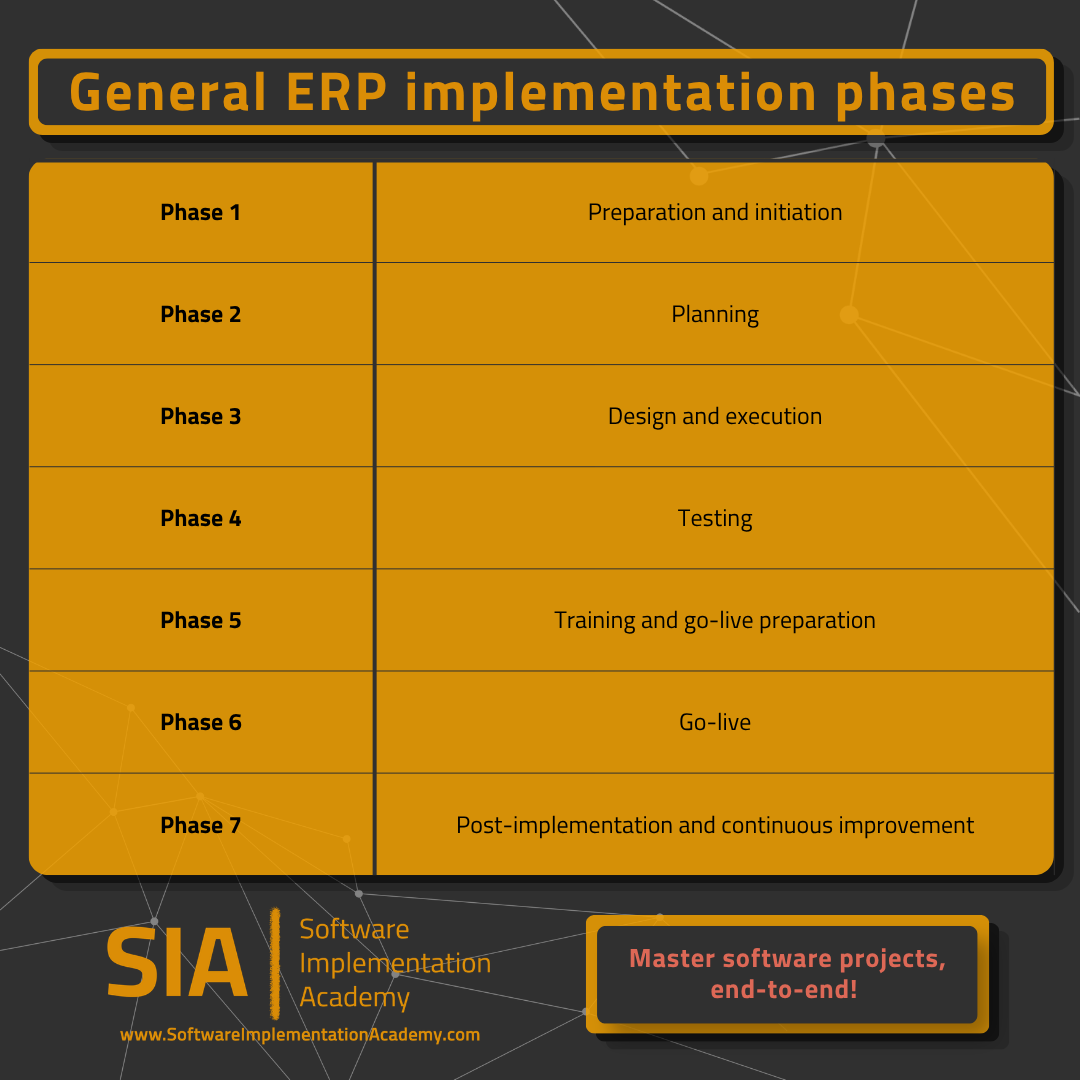
There is no universal ERP implementation approach suitable for every organization. Various ERP vendors, implementation partners, and organizations rely on different setups.
Notwithstanding this, most ERP project implementations follow a handful of broad identifiable phases.
Being familiar with these ERP implementation stages allows each project member to recognize how their specific tasks fit into the bigger picture.
Phase 1: Preparation and initiation
The first phase establishes the foundation for the ERP project.
Typical activities include:
-
Defining business objectives
-
Establishing project scope
-
Identifying stakeholders
-
Assessing organizational readiness
-
Establishing governance
-
Selecting the ERP solution and implementation approach
-
Identifying project risks
-
Defining initial success criteria
Aligning the business with IT perspectives and goals during this stage is particularly crucial.
Top-Management support and effective communication are important factors for successful implementation of an ERP system. A UK-based study with 296 medium-sized and large companies found that initial planning, top-management support, and explicit communication have a high impact on ERP systems implementation success.
The lesson is straightforward:
Establish the foundation of your project before you have the first problem in the implementation.
Phase 2: Planning
The planning phase translates the implementation objectives into an actionable ERP implementation plan.
This can include:
-
Project schedules
-
Workstream setups
-
Resource planning
-
Governance structures
-
Decision-making processes
-
Risk and issue management
-
Communication planning
-
Testing strategy
-
Data migration planning
-
Training planning
-
Cutover planning
An additional important feature of a good ERP implementation project plan is that it displays dependencies.
For example: data migration, integration, configuration, and testing may not always be independently planned.
An ERP project team should, because of this, be able to see the individual workstreams and how they interact.
Phase 3: Design and execution
During execution, the organization begins translating business requirements into the future solution.
Activities can include:
-
Business-process analysis
-
Process redesign
-
ERP configuration
-
Custom development
-
Integration development
-
Data preparation
-
Security and role design
-
Documentation
-
Initial testing
That is also where the distinction between implementation and development becomes relevant. An ERP implementation is not an application development project. The aim is to deliver an operational business solution that people can employ, support, and sustain in the long run.
Another prominent area that many studies highlight is the critical success factors, which show the prominence of business-process re-engineering, ERP team composition, project management and clear communication, and the compatibility between the ERP system and business processes.
Phase 4: Testing
Testing is one of the most important control points in an ERP implementation; however, technical testing alone cannot guarantee proper functioning.
Test the entire business process with all relevant people groups. Use realistic data, integrations, and systems that will be used in production.
Examples include:
-
Unit testing
-
Integration testing
-
System testing
-
End-to-end business-process testing
-
User acceptance testing
-
Data migration testing
-
Performance testing
-
Security testing
Involve the users when the task needs their experience.
Based on this, testing can serve multiple purposes: It highlights software defects, wrongly configured workflows, and helps people adapt to new ways of working.
In many cases, lack of testing has been cited as a risk in ERP implementation. Undiscovered issues quickly rise to the surface and show their disruptive consequences once the system is operational.
Phase 5: Training and go-live preparation
People need to be able to work with the ERP system to generate value. Training should not be classified as a final administrative step just before go-live.
The trainings should be delivered at the right time and level. Seasoned with practical and simulation-based exercises, the training will be even more effective.
Research literature has consistently recognized training and education as key factors for successful ERP implementation.
As part of the go-live preparation, several aspects need to be considered:
-
Setup of different user roles
-
AS-IS and TO-BE business processes
-
Review of new responsibilities
-
Issue and incident management processes
-
Established support structures
-
Escalation procedures
Phase 6: Go-live
The go-live moment marks the transition from the current way of working to the new ERP system. Depending on the organization’s strategy, the implementation may use:
-
A big-bang approach
-
A phased rollout
-
A geographical rollout
-
A business-unit rollout
-
A process-based rollout
Go-live moment covers more than the technical cutover: the business itself needs to change the processes.
Just because a go-live is technically successful, it does not mean it won’t become an operational issue if people do not know how to use the system or cannot get the support they need to use it effectively.
Phase 7: Post-implementation and continuous improvement
Go-live is undoubtedly a highly significant project milestone; however, it is not the finish line.
Once the new ERP is implemented, organizations will then be required to assess if the system and processes deliver the desired results.
Useful measures can include:
-
User adoption
-
Process and system performance
-
Error rates and issue-resolution times
-
Data quality
-
User feedback
-
Business benefits
-
Return on investment
Post-implementation reviews can also reveal lessons that should be applied to future software implementation projects.
ARE YOU READY to take your knowledge to a new level?
Review our End-To-End Masterclass
for comprehensive knowledge.
Start your journey today!
ERP implementation best practices
ERP implementation best practices can guide organizations to minimize avoidable risks.
Establish clear business objectives
An ERP project must have clearly defined goals.
Specify what action the organization intends to change and how the organization will determine if it has been successful.
Lack of clear goals can push project choices towards software delivery rather than delivery of business value.
Build a capable implementation team
ERP deployment demands business, project, and technology skills.
The team may include:
-
ERP project manager
-
Business process owners
-
Functional consultants
-
Technical consultants
-
Developers
-
Data specialists
-
Integration specialists
-
Change managers
-
Key users
-
IT and business representatives
Survey results indicate that project-team competence and the appropriate composition of the team have a significant impact on ERP implementation success.
Software Implementation Academy can broaden team members’ knowledge of software implementation concepts, required processes, and tasks.
Connect business and IT
ERP projects can fail when business and IT are working independently. Operations requirements are clear to business teams. IT teams understand IT knowledge, architecture, security, integration, and support needs.
Software implementation projects need both!
You need continued cooperation from both parties to complete a successful ERP implementation.
Involve users early
End users are well aware of the realities of day-to-day work.
Their involvement can help identify:
-
Process exceptions
-
Missing requirements
-
Usability issues
-
Training needs
-
Data problems
-
Operational risks
Involvement of users should extend into design, training, and post-go-live enhancements.
Treat data migration as a business activity
ERP migration has become stereotypically characterized as a technical task. In practice, data quality is also the ownership of business.
Organizations need to determine:
-
Which data should be migrated
-
Who owns the data
-
Which records require cleansing
-
Which historical data is necessary
-
How data will be validated
-
How migrated data will be reconciled
Using dirty or unreliable data can erode trust in the new system and cause additional headaches long after go-live.
Manage customization carefully
ERP software must be a good fit to business requirements; still, over-customising can drive up complexity and its associated cost, as well as its long-term maintenance.
Before requesting customization, teams should understand the business rationale for the requirement and determine if ERP standard functionality can satisfy the need.
Communicate continuously
Communication should not be only project-status reports. Diverse stakeholders require different information.
The sponsor may require an understanding of critical risks and decisions. A business user would be interested in knowing how this impacts their work. IT staff require information about architecture, integration, and support. A project manager needs to see across all those views.
Prepare people, not just systems
One of the biggest errors you can make in software implementation is believing that, if you configure the software successfully, then you have implemented the software successfully.
It is false. End users need to understand:
-
What is changing
-
Why it is changing
-
How their work will change
-
What they need to learn
-
Where they can get support
That is why implementation training, communication, and change management are vital parts of the ERP implementation life cycle.
How SIA can help ERP implementation teams
Teams and key decision-makers responsible for ERP implementations may need a deeper understanding of the implementation process.
This is where Software Implementation Academy can complement project training, vendor-specific training, and consulting support.
SIA provides software-agnostic learning materials specifically focused on software implementation projects. The self-service platform combines video training, downloadable templates, individual activities, and 1-on-1 sessions to help professionals understand implementation flows, overcome barriers and pitfalls, and contribute to or lead successful implementations.
The material can be useful for professionals involved in different parts of an ERP implementation, including:
-
ERP project managers
-
Implementation managers
-
Technical-functional consultants
-
Software developers
-
CIOs and CTOs
-
Project coordinators
-
PMO professionals
-
Change managers
-
Program managers
-
Customer success managers
-
IT consultants
-
Project contributors
These audiences are central to the implementation ecosystem and often need to understand how their individual responsibilities connect to the wider project.
Learn before the project becomes difficult
SIA’s training focuses on practical implementation knowledge, methodologies, concepts, and tools that professionals can apply in real software implementation projects.
For example, an implementation professional can use structured learning to improve their understanding of:
-
ERP implementation phases
-
Software implementation processes
-
Project planning
-
Implementation barriers
-
Implementation pitfalls
-
Stakeholder cooperation
-
Business and IT alignment
-
Implementation methodologies
-
Testing
-
Data and integration considerations
-
Project management
-
Post-implementation activities
The objective is to build knowledge and talent in-house and not to rely on an external party, such as the ERP vendor or integration partner.
ARE YOU READY to take your knowledge to a new level?
Review our End-To-End Masterclass
for comprehensive knowledge.
Start your journey today!
Measuring ERP implementation success
A successful ERP implementation should be evaluated against business and operational outcomes rather than simply asking whether the system went live.
Useful indicators include:
User adoption
Are employees using the ERP system as intended?
Process performance
Are important processes faster, more consistent, or less dependent on manual work?
Data quality
Is the organization working with reliable and usable data?
Issue resolution
Are implementation and operational issues being identified and resolved efficiently?
Business benefits
Are the original objectives of the ERP project being achieved?
Return on investment
Does the overall value justify the investment in the ERP software, implementation, and organizational change?
These measurements help organizations distinguish between deploying an ERP system and successfully implementing an ERP system.
ERP implementation FAQs
What is the ERP implementation process?
The ERP implementation process is the structured path that you take to plan, select/build, test, deploy, and support a new ERP system. This process generally consists of several specific tasks, or phases, such as readiness assessment, planning, design, testing, training, go-live, and post-go-live support.
How long does an ERP implementation take?
Often, ERP implementations last for several years. Is there a set duration? Not really. Length of time depends on size, scope, number of locations, business processes, integrations, data complexity, level of customisation, resources, and implementation approach.
A more realistic implementation plan would acknowledge these interdependencies and not impose an artificially imposed deadline.
What are the biggest ERP implementation challenges?
Typical ERP implementation failures include poor project management, lack of clear implementation goals, inadequate expertise, weak stakeholder involvement, poor communication, lack of adequate end-user training, data-quality problems, complex integration, tight project deadlines, limited testing, and resistance to organizational change. Many of these are cited as major challenges in implementation.
What causes ERP implementation failures?
ERP implementation failures are seldom due to a single factor.
They can also be due to a mix of poor planning, weak or unfocused governance, lack of resources, poor project management, bad data, poor communication, poor user involvement, inadequate training, inappropriate customization, or poor post-go-live support.
The key question is not just “which ERP system should we implement?”
But also: “Are we ready to implement it successfully?”
How can I learn more about ERP implementation?
Implementation knowledge can be built by ERP professionals from project experience, vendor training, consulting experience, professional communities, and structured implementation training.
Software Implementation Academy provides software-agnostic implementation training: detailed implementation advice, tools, and resources for practitioners seeking to learn about software implementation projects and deepen their ability to support or lead them.
Conclusion
An ERP implementation is a technological business transformation project. The ERP software represents just one component of the overall solution.
Key factors that can contribute to the success of the implementation include: clear objectives, good project management, skilled teams, strong business and IT partnerships, high-quality data, fit-for-purpose processes, involved users, structured training, good communication, and good continuous improvement.
These are also the areas in implementation projects where barriers and pitfalls are often encountered.
ERP project managers, consultants, CIOs, PMO teams, change managers, and other project team members, who gain a big-picture view of the ERP implementation process will be able to identify risks more easily, make better decisions, and work more effectively with others involved in the project.
The more familiar your implementation team is with the overall software implementation process, the more equipped they will be to handle the complexities that do happen.
That is the purpose of Software Implementation Academy: enabling smart and efficient software implementations through practical, software-agnostic implementation knowledge.