Understanding the root causes
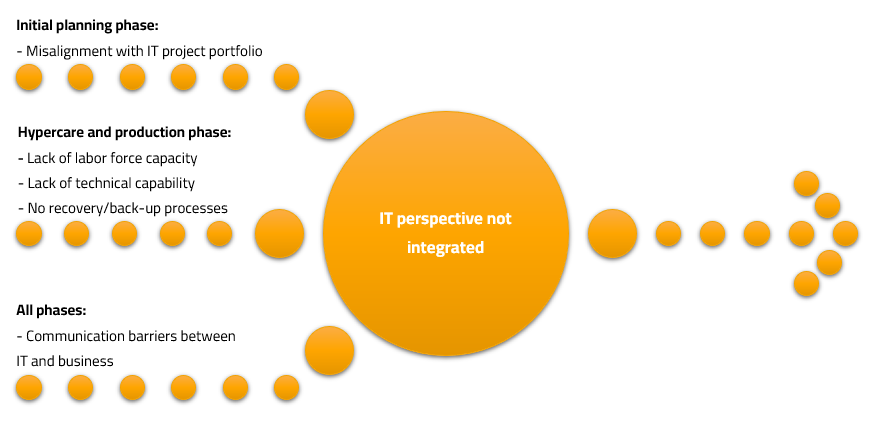
By the nature of ERP implementation projects, the driving and triggering factor is the fundamental need for a solution to centralize data, increase productivity, and increase return-on-investment (…) forms on the business side. Depending on the culture of the enterprise and its attitude towards IT as a functional unit, the level of IT involvement differs largely. In some enterprises, the role of IT is considered a competitive edge and as a pulling force to overtake market competitors by adopting technological advancements, while other enterprises utilize IT as a supporting function only to serve operational issues and provide a stable foundation for business goals. Dey, Bennett and Clegg (2021, p. 7) highlight that not meeting IT specifications (hardware, software, network, security); mismanagement of overall IT architecture; and IT failing to resolve functional issues greatly impact ERP implementation projects. Relying on the above-mentioned concept, the perspective of IT in implementation projects might not be fully recognized for the following reasons:
Upon the formation of the project in the initial planning phase, the newly introduced ERP implementation project has to be aligned with the strategic goals of IT. Reflecting on the previous paragraph, harmonization and delegation of strategic goals might not be clear-cut. If the stated alignment does not occur between the business and IT on a profound level, then the risk of misalignment increases.
During the production phase of the implementation, the supporting IT unit needs to assess labor force capacities and the required technical capabilities to provide adequate support. Labor force capacities might extend to recurring safety back-ups, continuous system monitoring, ad-hoc requests, and system developments, while technical capabilities cover the enhancement of existing IT infrastructure, from both hardware and software perspectives.
Throughout all phases of the implementation project, communication might face barriers if communication is not aligned, wrong communication styles are applied, or the differences between personality types are not recognized.
Stabilizing the root causes
In order to overcome these barriers, the project team has to ensure that the perspective of IT plays an organic role in the project formation. Involvement of IT shall occur in the first place when the project is being formed to gain their support and positive engagement. In general, large-sized enterprises tend to have a vast number of IT-related projects at the same time, thus immediate notification is crucial so that the high-level IT representatives can assess the attributes of the project.
By the time of the production phase of the ERP implementation project, the supporting IT unit shall be aware of the long-term labor force capacities and technical capabilities reserved by the project. In a form of continuous alignment between business and IT, the business needs to assess future tasks (roadmap) where IT involvement is required, so that IT unit leaders can allocate resources effectively. Although the technical expansion of the IT infrastructure already occurred in the solution design phase to prepare test environments for the ERP software, refinements and further enhancements are advised to be reviewed to eliminate any bottlenecks from the daily operation. Based on the business requirements, IT shall assess the most optimal backup processes and recovery steps for any unexpected events.
The project team shall notice that not only are business stakeholders present in the project, but the stakeholder list shall embrace the technical staff and their supervisors for extensive engagement. The elimination of communication barriers is a key element for the cooperation of the two parties; thus, learning the goals and duties of each party, speaking a common language, openness, and collaboration are crucial (Rivera, 2017).
Summary in short
- Ensuring close collaboration between IT and business from the initial project formulation.
- Assessing extensively the IT-side requirements for the software implementation (eg. hardware, software, network, security, etc.).
- Aligning and formulating the software's product roadmap mutually by IT and business.
- Allowing precise estimation and planning proper resourcing capacities for new IT activities (eg. safety back-up, system uptime, 1st level support duties, etc.).
- Maintaining active collaboration between IT and business, and delegation from both parties to key decision-making.
ARE YOU READY to take your knowledge to a new level?
Review our End-To-End Masterclass
for comprehensive knowledge.
Start your journey today!
Bibliography
– Dey, P. K., Bennett, D. & Clegg, B., 2021. Managing risk in enterprise resource planning projects, Birmingham: Aston Business School.
– Rivera, A., 2017. How to Improve Management-to-IT Communications. [Online] Available at: https://www.businessnewsdaily.com/10304-improve-communications-between-management-it.html [Accessed 19 02 2021].