Understanding the root causes
ERP implementation projects change well-embedded processes that are executed by employees thus, the involvement of all participants is crucial. The business process transformation enables increased productivity and efficiency only if employee awareness is magnified, future benefits are recognized, goals are clear, and the approaching path is well-communicated. If change management plans are deficient, then the previously mentioned points are not well-founded and might contribute to the failure of adaptation (Ranjan, Jha & Pal, 2016).
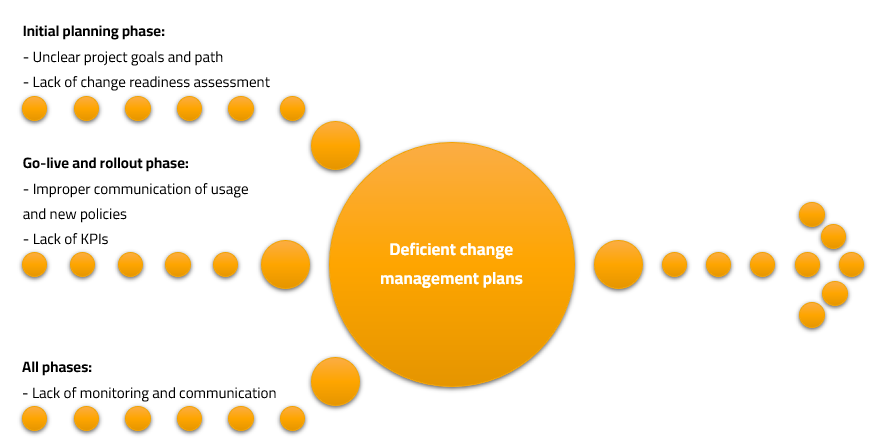
Deficient change management plans show signs at multiple phases of the project:
In the initial planning phase of the ERP project, the ultimate project goals and the path might not be clearly defined in a comprehensible and digestible way for all stakeholders. In addition, if the enterprise did not deploy a change readiness assessment before launching the implementation, then the change management plans might be ungrounded or inaccurate (Deloitte, 2021).
In the go-live and rollout phase, the usage and new policies might not be communicated properly, resulting in unclear processes, roles, and responsibilities that lead to confusion and huddle. Moreover, the absence of key performance indicators (KPI) does not facilitate employees and middle managers to conform to new practices and acceptance (Guerrero & Eterovic, 2004).
Throughout the whole project cycle, the lack of communication might generate tension as stakeholders are not involved to a sufficient level. Furthermore, the lack of stakeholders’ behaviour monitoring raises barriers in effective communication and expectation management.
Stabilizing the root causes
The initial planning phase shall incorporate defining the project goals, scope, ambitions, constraints, and limitations. All these attributes must be handled transparently and should be communicated to stakeholders to prepare their acceptance. Bi-directional communication, multiple opportunities for employees to raise their concerns or questions, would diminish employee resistance (Alsher, 2017). Top managers tend to deploy change readiness assessments to survey the willingness of the enterprise to change, for instance, technological adaptability, tech-savviness of employees, historical change reaction, the workload in the period, change fatigue, etc. The survey’s result supports decision-makers to launch or postpone the project (Deloitte, 2021).
As final users commence to use the software on a daily basis, they need to be clearly guided on who/why/where/when/how/what they should do via the adoption of new policies and protocols. It is recommended for the management to set KPIs to raise the importance of new practices and to assign priority (Sun, Ni & Lam, 2015).
Last but not least, the project team and the management shall continuously monitor the behavioural change of stakeholders and their level of commitment. Communication embraces the whole project to supply decent information at the right time through the proper channels, thus, it is suggested to support the transition with a tailor-made change management strategy (Al-Shamlan & Al-Midimigh, 2011). Such a strategy shall incorporate effective communication, expectation, training, and resistance management plans. Periodical surveys can serve as a supporting tool to assess the commitment of stakeholders.
Summary in short
- Assessing the readiness of the organization for the implementation.
- Clarifying goals, boundaries of the project, roles and responsibilities, and clearly communicating processes.
- Facilitating bi-directional communication, giving room and confidence for feedback and concerns.
- Holding the hands and guiding the end-users on their daily operational tasks during training and after go-live.
- Surveying the behaviour of the stakeholders, assessing their engagement.
ARE YOU READY to take your knowledge to a new level?
Review our End-To-End Masterclass
for comprehensive knowledge.
Start your journey today!
Bibliography
– Ranjan, S., Jha, V. K. & Pal, P., 2016. Literature review on ERP implementation challenges. Int. J. Business Information Systems, 21(3), pp. 388-402.
– Deloitte, 2021. Your guide to a successful ERP journey, Québec: Deloitte Design Studio.
– Guerrero, F. & Eterovic, Y., 2004. Adopting the SW-CMM in a Small IT Organization. IEEE Software, 21(4), pp. 29-35.
– Alsher, P., 2017. A Change Management Dilemma: 5 Barriers You Can Anticipate to Technology Adoption. [Online] Available at: https://www.imaworldwide.com/blog/a-change-management-dilemma-5-barriers-you-can-anticipate-to-technology-adoption [Accessed 27 10 2020].
– Sun, H., Ni, W. & Lam, R., 2015. A step-by-step performance assessment and improvement method for ERP implementation: Action case studies in Chinese companies. Computers in Industry, Volume 68, pp. 40-52.
– Al-Shamlan, H. & Al-Midimigh, A., 2011. The Chang Management Strategies and Processes for Successful ERP Implementation. IJCSI International Journal of Computer Science Issues, Volume 8, pp. 399-407.