Understanding the root causes
An ERP software implementation project requires a vast number of skills within the project team. The balance between IT and business skills has to be maintained in order to represent both parties during the project and align the requirements between them (Kim, 2004). If the project team lacks skills, then the implementation might lead to dissatisfaction from the management side and discomfort from the final user side.
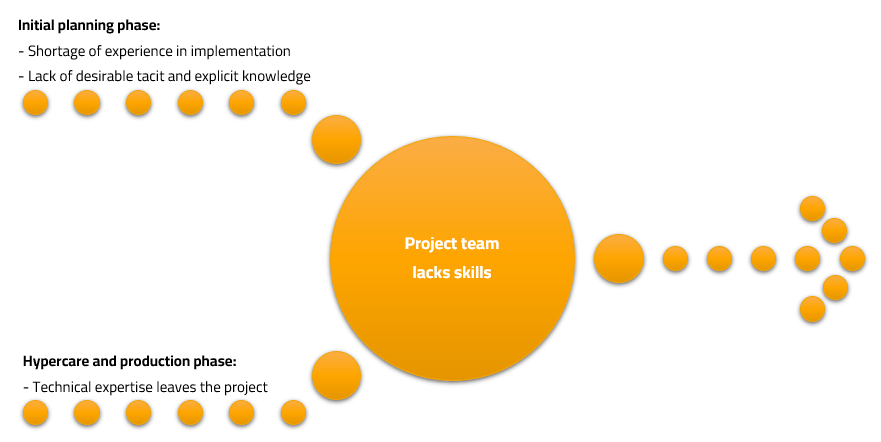
During the initial planning phase of the project, the project team might not be able to oversee the project for planning and estimation purposes as they lack experience in implementation or integration projects. On the contrary, expert judgement is often utilized to adapt standard implementation methodologies to unique enterprise attributes (Erasmus & Daneva, 2013). The project team could be deeply skilled; however, if the approach is not harmonized with the organizational culture, then the project team might deploy undesirable soft skills, such as over-delegation, leading by authority, no willingness for conflict resolution (Cook, 2014).
Once the project has ended and the production phase begins, management often does not facilitate retaining the project team members within the umbrella of the enterprise. If experienced project team members abandon the enterprise, then recruitment and onboarding processes are time-consuming, furthermore, the knowledge of internal processes might be lost depending on the quality of handover-takeover (Markus et al., 2000; Siriluck, 2010).
Stabilizing the root causes
Lack of skills on the project team side implies multiple issues in the implementation project; to overcome these barriers, the following section might offer remedies.
In the initial planning phase of the project, the project sponsors shall ensure that the project team is configured from skilled and experienced members that are matching to the organizational attributes. According to a skill-model, developed by Katz (1955), most skills are associated with three categories: technical, human, and conceptual. The project team shall possess skills regarding (1) techniques, processes, and workflows; (2) collaboration, interaction, communication, and emotional intelligence; and lastly (3) cognitive, logical, and analytical, goal-setting skills (Yukl, 2002; Mahdavian & Mostajeran, 2013). Besides, it is advised to establish a tailor-made training policy for project team members to improve their competence (Habib, 2009).
Management needs to safeguard that the project team members are retained in the enterprise once the project finishes in order to provide adequate business continuity to the ERP operation. Callejas and Terzi (2012) point out that retention heavily depends on salary and benefit expectations. Furthermore, the more customized the ERP system is, the enterprise becomes more and more dependent on internal expertise.
Summary in short
- Ensuring that project members not only possess relevant IT skills but also business domain knowledge.
- Facilitating a low level of fluctuation of project team members to retain knowledge within the project and maintain efficiency.
- Providing opportunity and room for continuous learning and development of project members.
- Considering emotional intelligence, soft skills, and tacit knowledge of project participants, besides educational background and work experience.
- Collaborating with the knowledge and growth department of the organization to improve desired skill sets.
ARE YOU READY to take your knowledge to a new level?
Review our End-To-End Masterclass
for comprehensive knowledge.
Start your journey today!
Bibliography
– Kim, H. W., 2004. A Process Model for Successful CRM System Development. IEEE Software, 21(4), pp. 22-28.
– Erasmus, I. P. & Daneva, M., 2013. ERP Effort Estimation based on Expert Judgements. In: Joint Conference of the 23rd International Workshop on Software Measurement (IWSM) and the 8th International Conference on Software Process and Product Measurement (Mensura). Ankara: IEEE, pp. 104-109.
– Cook, R., 2014. Top Barriers to ERP Success. [Online] Available at: https://www.toolbox.com/tech/erp/blogs/top-barriers-to-erp-success-062514/ [Accessed 27 10 2020].
– Markus, M. L., Axline, S., Petrie, D. & Tanis, C., 2000. Learning from adopters’ experiences with ERP: problems encountered and success achieved. Journal of Information Technology, Volume 15, pp. 245-265.
– Siriluck, R., 2010. Success Factors of Large Scale ERP Implementation in Thailand. World Academy of Science, Engineering and Technology(40), pp. 605-608.
– Katz, R. L., 1955. Skills of an Effective Administrator. Harvard Business Review Press, pp. 33-42.
– Yukl, G., 2002. Leadership in Organizations. 5th ed. Upper Saddle River: Prentice-Hall.
– Mahdavian, M. & Mostajeran, F., 2013. Studying key users’ skills of ERP system through a comprehensive skill measurement method. International Journal of Manufacturing Technology, Volume 69, pp. 1981-1999.
– Habib, Z., 2009. The Critical Success Factors in Implementation of Software Process Improvement Efforts: CSF’s, Motivators & Obstacles. Gothenburg: University of Gothenburg.
– Callejas, J. F. & Terzi, C., 2012. Review of Enterprise Resource Planning (ERP) systems in Unites Nations organizations, Geneva: United Nations, Joint Inspection Unit.