Understanding the root causes
User involvement plays an important role during an ERP implementation. Panorama Consulting Solutions (2019) claims that the contribution of employees has a direct influence on the success of such projects. Continuous involvement of users is essential as they will be the final and end-users who utilize the functions provided by the system. According to Hartwick and Barki (1994, p. 441), user involvement is defined as ”a psychological stage of the individual, and mirrors the importance and personal relevance of a system to a user”. Lack of user involvement stems from many issues:
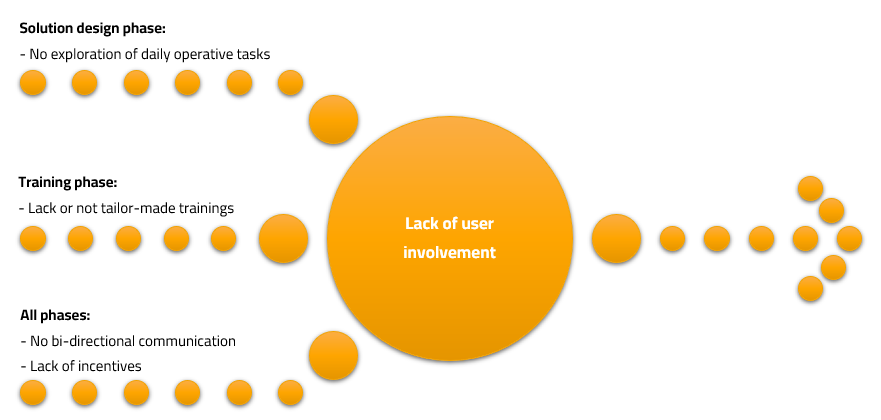
In the solution design phase, the internal process modelling might not stem from the individual employees but from the supervisors or only from industry best practices. This way, the operative tasks are not assessed properly, and the users are not involved in the cooperative work with the project team.
During the training phase of the implementation, employees might not receive training at all, or the training is not utilized well. In the latter, training might not be tailor-made to accommodate the level of IT or business knowledge, and the training contains unexplained expressions. Furthermore, employees are not able to participate in training due to wrong time scheduling, overpressured tasks, or differing guidance from their supervisors. Dey, Bennett and Clegg (2021) highlight that inadequate training has a high impact on the success of implementations.
Throughout the whole lifecycle of the implementation, a lack of user involvement occurs if bi-directional communication does not exist as the project team or management does not offer appropriate channels for it, and employees are not rewarded for their contribution to the project.
Stabilizing the root causes
To overcome the barrier of a lack of user involvement, the project team and management have to continuously involve the employees and monitor their attitude to adopt the ERP system. User involvement decreases the resistance of employees and improves the benefits gained at the end of the implementation (Willcocks & Sykes, 2000).
First and foremost, the project team has to ensure that the employees detail their daily operational tasks as input to the project. This way, not only is the quality of assessment increased due to the unfiltered information, but employees might suggest corrective actions for the desired status of processes.
Second, it is crucial that the project team assesses training requirements before delivering them (Deloitte, 2021). Technical savviness, understanding of business practices, historical experience with ERP systems, language- and time constraints, desired training format shall be noted and the training shall be tailor-made for these principles to maximize the effectiveness. Furthermore, working groups might be established for similar job positions where experts in certain fields can share their tips and practices (Habib, 2009).
Lastly, the project team and the management shall facilitate user involvement throughout the whole project by establishing bi-directional and mutual communication channels. For instance, forums for knowledge sharing or question & answer sessions shall be held, where employees can raise their concerns or questions regarding the ERP system or the implementation. Supervisors shall reward (KPI setting, periodical bonus, increased training budget, etc.) their employees for their valuable contributions to engage and maintain the connection to the project.
Summary in short
- Involving end-users as early as possible to incorporate valuable insights and let their voice be heard.
- Re-/designing processes and workflows with the active participation of end-users.
- Providing tailored training to end-users is a fundamental step in involvement.
- Providing a platform for bi-directional communication between the project team and end-users, a room for raising concerns and sharing tips.
- Incentivizing employees (eg. KPI setting, periodical bonuses) also facilitates employee engagement to a certain extent.
ARE YOU READY to take your knowledge to a new level?
Review our End-To-End Masterclass
for comprehensive knowledge.
Start your journey today!
Bibliography
– Panorama Consulting Solutions, 2019. 2019 ERP Report: People, Process, Technology, Denver: Panorama Consulting Group.
– Hartwick, J. & Barki, H., 1994. Explaining the role of user participation in information system use. Management Science, 40(4), pp. 440-465.
– Dey, P. K., Bennett, D. & Clegg, B., 2021. Managing risk in enterprise resource planning projects, Birmingham: Aston Business School.
– Willcocks, L. P. & Sykes, R., 2000. Enterprise Resource Planning: The Role of the CIO and IT Function in ERP. Communication of the ACM, 43(4), pp. 32-38.
– Deloitte, 2021. Your guide to a successful ERP journey, Québec: Deloitte Design Studio.
– Habib, Z., 2009. The Critical Success Factors in Implementation of Software Process Improvement Efforts: CSF’s, Motivators & Obstacles. Gothenburg: University of Gothenburg.