
Understanding the root causes
Unrealistic expectations can refer to all three aspects of the Iron Triangle: project scope, schedule, and cost. A retrospective ERP implementation survey (Data collection: 2019; No. of respondents: 241; Avg. no. of employees: 1,080; Percentage of multinational organization: 44%) published by Panorama Consulting Solutions (2019, p. 39) highlights that 48% of responding enterprises denoted timeline overruns due to unrealistic project timelines, and enterprises underestimated their implementation timeline by 11%. Moreover, 33% of respondents noted budget overruns due to unrealistic project budgets.
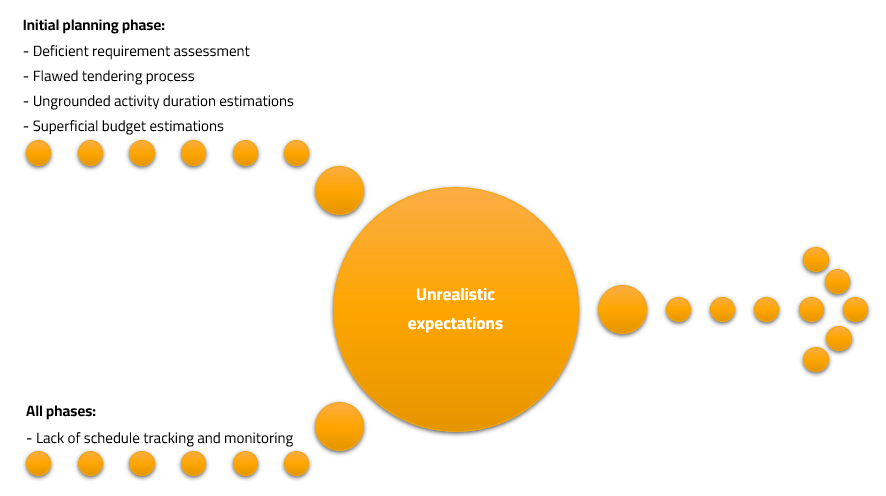
Targeting unrealistic expectations mainly occurs in the initial planning phase when the project team and managers determine the necessary scope, baseline schedules, and costs. The deficient capture of requirements can cause delays throughout the project as final users recognize that some functions are missing from the system, and it blocks productive work. In such a scenario, both the schedule and the cost baseline have to be amended, leaving the project with overruns. Another source of unrealistic expectations might be the wrong or flawed tendering process if the requirements do not match the selected system. If functions are missing from the selected system, it poses an issue; if a way more complex software is chosen than the necessary level, then it is often at the expense of user-friendliness, usability, and transparency of the system. Moreover, the precise estimation of implementation activity duration and budget allocation plays a major role in setting unrealistic expectations. If the project team underestimates activity durations, then the project schedule will not be on track throughout the implementation. Similar to the activity estimations, the budget elements need to be carefully assessed and determined before budget allocation.
Throughout the project lifecycle, the lack of a schedule tracking and monitoring mechanism can contribute to unrealistic expectations. Once the baseline schedule is constructed and accepted by stakeholders, it has to be continuously monitored by the project team to spot possible delays.
Stabilizing the root causes
In order to find remedies for the above-mentioned findings, multiple aspects have to be considered:
First, the project team needs to ensure that the requirement assessment is delivered extensively, utilizing expert judgment and fitting techniques. According to Vilpola and Kouri (2005) and Reqtest (2018), many business analyst tools can serve such a purpose: Unified Modeling Language (UML), flowchart plotting, GAP analysis, and data flow diagrams. Such analysis tools are recommended to be used in the solution design phase as well to assess dependencies, relations, and priorities between elements. During the tendering process, the project team and the procurement department have to recognize the fact that the ERP vendor might be biased and might promote unfounded implementation costs and schedules (Harris, 2017). Such a type of proposed cost and schedule structure might be valid for the off-the-shelf software version that is pre-configured for industry best practices; however, not applicable to the enterprise’s tailor-made version that triggers additional costs and time. It is advised that the project team use proper and industry-specific benchmarking and observe past project history documents to recognize the unique attributes of the enterprise environment and internal assets. Such features increase the precision of estimation (Panorama Consulting Group, 2020). As per the activity duration estimation, the PMBOK published by the Project Management Institute (2017) suggests adapting a three-point estimation technique for worst-case, most-likely, and best-case scenarios to encounter schedule slips.
Second, the project team shall establish a strong governance model for all phases of the ERP implementation that is transparent and tailored for all participants of the project. The governance model shall include the schedule tracking and monitoring control points, including but not limited to project milestones (ERP Software Blog, 2016).
Summary in short
- Reassuring that the scope, schedule, and cost plans are extensive, benchmarked to industry standards, or other similar projects.
- Ensuring that the system selection process is comprehensive, covers business scenarios, and reflects the priorities of selection factors.
- Facilitating openness and trustworthiness so that expectations can be aligned with stakeholders more effectively.
- Adopting an estimation technique for planning that recognizes multiple outcomes, such as three-point (worst, most-likely, best scenarios).
- Establishing a project delivery governance model to implement periodic expectation reviews at project milestones.
ARE YOU READY to take your knowledge to a new level?
Review our End-To-End Masterclass
for comprehensive knowledge.
Start your journey today!
Bibliography
– Panorama Consulting Solutions, 2019. 2019 ERP Report: People, Process, Technology, Denver: Panorama Consulting Group.
– Vilpola, I. & Kouri, I., 2005. Improving ERP Requirement Specification Process of SMEs with a Customer-Centered Analysis Method. Frontiers of E-business Research, pp. 140-151.
– Reqtest, 2018. Requirements Analysis – Understanding the Process & Techniques. [Online] Available at: https://reqtest.com/requirements-blog/requirements-analysis/ [Accessed 19 03 2021].
– Harris, M. S., 2017. Three Lessons From ERP Implementation Failures. [Online] Available at: https://softwarenegotiation.com/three-lessons-erp-implementation-failures/ [Accessed 19 03 2021].
– Panorama Consulting Group, 2020. How to Develop an ERP Project Plan. [Online] Available at: https://www.panorama-consulting.com/erp-project-plan/ [Accessed 16 03 2021].
– Project Management Institute, 2017. A Guide to the Project Management Body of Knowledge (PMBOK Guide). 6th ed. Philadelphia: Project Management Institute.
– ERP Software Blog, 2016. Avoiding a Failed ERP Implementation – Top Tips for Setting the Timeline Right. [Online] Available at: https://www.erpsoftwareblog.com/2016/09/avoiding-failed-erp-implementation-top-tips-setting-timeline-right/ [Accessed 19 03 2021].