Understanding the root causes
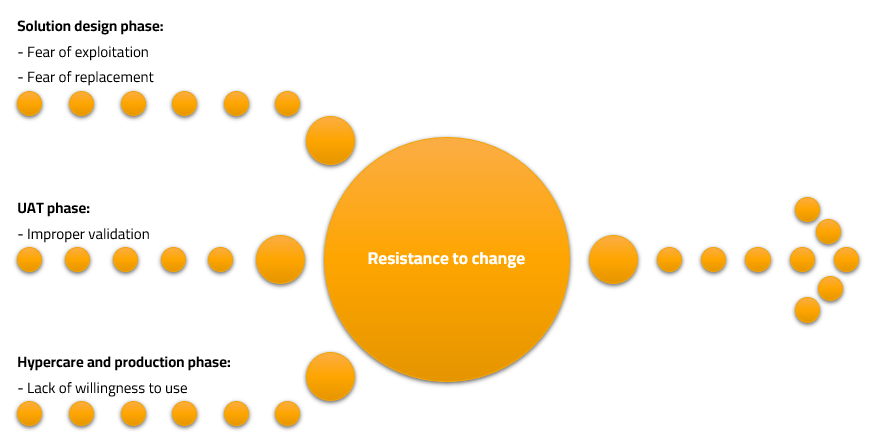
Based on the CIO survey published by Deloitte (2021), ’resistance to change’ was the most recurring barrier in ERP software implementation projects. Resistance to change refers to the phenomenon when employees do not want to adopt a newly introduced software, or when employees slow down the implementation processes. Resistance to change can stem from several sources and can occur at multiple major phases.
First, resistance might occur in the solution design phase when the existing AS-IS processes are mapped by experts. In such a scenario, employees might not share all details of their daily operational solutions as they are afraid of being exploited by the enterprise and becoming useless, as newcomers or replacement colleagues can reproduce their know-how. Employees might consider their daily operational solutions as their own intellectual property that they developed over the years. As a result of such behaviour, the business process modelling returns invalid processes and practices, thus the development itself will be false.
Second, employees do not assign proper importance to the user acceptance testing phase, which serves the controlling purpose of the development: to validate the developed solution if it matches the earlier collected requirements and test cases. If the UAT phase of the implementation is not controlled well by the final users, then the final ERP software might include bugs, wrong logical connections, and processes that are deteriorating the business performance.
Third, employee resistance can arise after the go-live event, when employees are expected to utilize ERP software as a daily tool for their work. Excuses might include that users were not participating in the earlier implementation phases, or they do not possess enough knowledge about the usage due to a lack of training.
Stabilizing the root causes
To overcome these barriers, the management communication has to ensure that final users understand the benefits and attributes of the ERP system integration. Final users would benefit from many advantages: decreased manual work, reduction of duplicated inputs, automated notifications, immediate access to data, etc. Moreover, reduction of the labor force is only a long-term attribute of ERP systems, thus, instantaneous lay-off would not be carried out (Al-Shamlan & Al-Midimigh, 2011).
Direct leaders have to ensure that their subordinates invest enough time in the implementation project (including training) if they are chosen to be representatives. In this respect, overburdening employees with non-implementation-related tasks is not advised, as they have to contribute quality work to the project. It is the role of the project team to involve the representatives in the specific phases of the implementation, such as the user acceptance testing phase. Employees have to be aware that their validation in this phase is crucial for the outcome of the project (Martin & Adams, 2011).
By the time the implementation project arrives at the production phase and users start to use the software, both the management and the project team have to ensure that final users are committed and equipped with extensive knowledge about the system. Involvement of final users throughout the development gains acceptance; training has to cover all future user functions. Similarly to the first point, the management has to clearly and effectively communicate the objectives, eliminate any ambiguous questions, aided by the change management plan.
Summary in short
- Establishing a safe and trustworthy environment by management so that employees can give constructive recommendations on daily operational tasks.
- Re-aligning the importance and impact of User Acceptance Testing with the representative.
- Promoting the benefits and emphasizing the advantages for the end-users of the digital transformation.
- Enabling project contributors to focus and invest time on the software implementation projects.
- Involving project contributors as early as possible and empowering end-users via training.
ARE YOU READY to take your knowledge to a new level?
Review our End-To-End Masterclass
for comprehensive knowledge.
Start your journey today!
Bibliography
– Deloitte, 2021. Your guide to a successful ERP journey, Québec: Deloitte Design Studio.
– Al-Shamlan, H. & Al-Midimigh, A., 2011. The Chang Management Strategies and Processes for Successful ERP Implementation. IJCSI International Journal of Computer Science Issues, Volume 8, pp. 399-407.
– Martin, B. & Adams, B., 2011. Organizational Change Management Strategy. Washington Community and Technical Colleges ERP Project, pp. 1-10.