
Understanding the root causes
An ERP software implementation project consists of more or less standardized and calculable steps and phases; however, the complexity requires advanced project management (abbreviated as PM) enterprise efforts. Poor project management approaches might dilute the quality of the deliverables, cause time delays, and increase the risk of cost overruns; all in all, it can deteriorate all aspects of the expected project attributes (Deloitte, 2021). The issue can stem from several sources in multiple phases of the ERP implementation project:
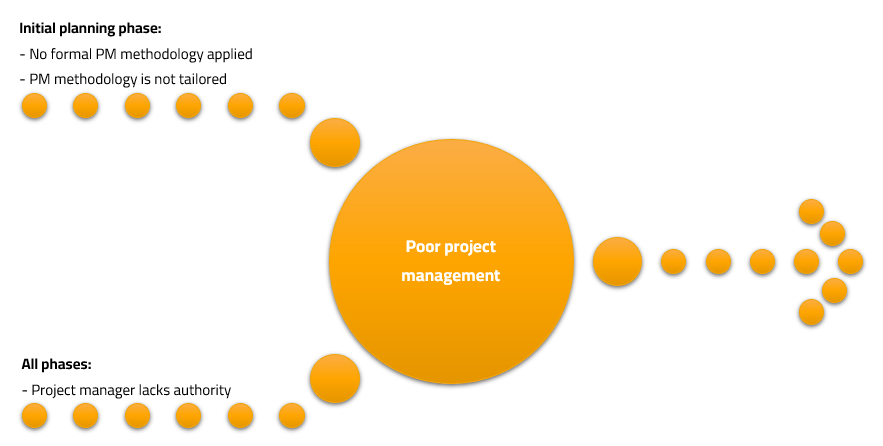
In the initial planning phase, the enterprise might not adopt any formal project management methodology since the benefits of methodologies are not known to project sponsors and senior management (Westland, 2006). It is often the case that decision-making bodies have not yet discovered the gains and added value of formally accepted project management methodologies. In other cases, the enterprise has successfully adopted a formal methodology, but it is not tailored to the attributes of the project and its environment.
A triggering factor for poor project management throughout all phases of the project lifecycle might be that, although the enterprise endorsed the usage of a formal methodology, the project manager has no adequate authority. Such a scenario might stem from the functional or weak-matrix organizational structure, in which project managers lack authority, cooperation with functional managers is limited, and stakeholders underprioritize project contribution by their individual functional goals (Siriluck, 2010).
Stabilizing the root causes
In light of the possible root causes, the elimination of the poor project management barrier needs to be approached from diverse angles:
First and foremost, the decision-making bodies have to recognize the added value of a formal project management methodology. Internal project management training of enterprises might not be as detailed and thorough as a globally utilized, well-acknowledged project management standard, such as PMI’s PMBOK or Axelos’ PRINCE2. Certification schemes of these standards represent the knowledge and expertise of project managers and project members. As it was mentioned earlier, these methodologies offer best practices, tools, templates, and frameworks that can be applied to ERP implementation projects to improve the success rate. It is important to highlight that these standards offer best practices for any project and any enterprise, hence, tailoring is essential. The selected methodology needs to be harmonized with the corporate culture, accommodated to the internal and external factors of the project, and relevant tools and techniques selected (Project Management Institute, 2017). A strong project governance model might also reveal integration with other projects, allowing the enterprise to benefit from the synergy.
Second, the project sponsors and senior managers need to ensure that the project receives elevated priority, along with sufficient authority for the project manager. Even if the enterprise structure is weak-matrix or completely functional, collaboration and cooperation at the senior management level are a must to support the success of the project.
Summary in short
- Adopting a formal project management methodology for project delivery.
- Tailoring the formal project management methodology to suit the organization's unique attributes and needs.
- Demonstrating the values and promoting the usage of a formal project management methodology.
- Equipping the project manager with a sufficient level of authority within the organization to enable efficient task distribution.
- Establishing a strong project governance framework within the organization to facilitate synergies between projects.
ARE YOU READY to take your knowledge to a new level?
Review our End-To-End Masterclass
for comprehensive knowledge.
Start your journey today!
Bibliography
– Deloitte, 2021. Your guide to a successful ERP journey, Québec: Deloitte Design Studio.
– Westland, J., 2006. The Project Management Life Cycle. London, Philadelphia: Kogan Page Ltd..
– Siriluck, R., 2010. Success Factors of Large Scale ERP Implementation in Thailand. World Academy of Science, Engineering and Technology(40), pp. 605-608.
– Project Management Institute, 2017. A Guide to the Project Management Body of Knowledge (PMBOK Guide). 6th ed. Philadelphia: Project Management Institute.