
Understanding the root causes
Many researchers claim that senior or top management support is essential to successfully conclude the ERP implementation project. Alsher (2017) points out that consistent and demonstrated commitment and ownership are critical at managerial levels as they support the adoption of the new system, eliminate resistance, and contribute to change management principles. If the project does not enjoy the support of the top management, then the motivation of employees weakens; resource allocation to the project is not prioritized, and the project faces barriers at all operational levels.
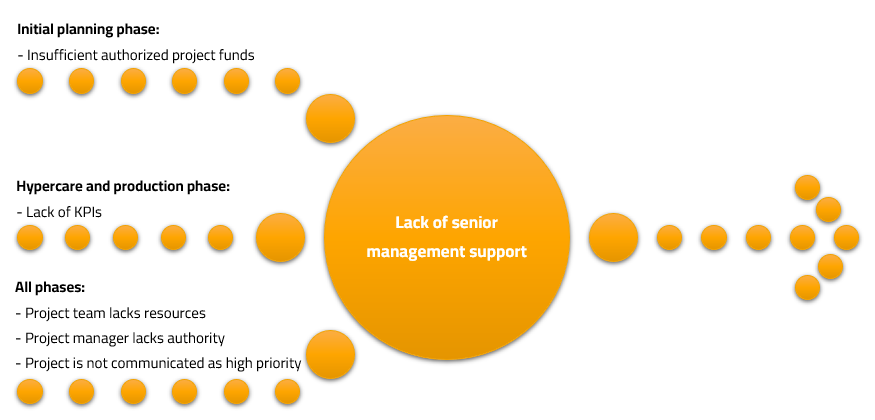
In the initial planning phase of the project, the absence of senior management support might cause budget-related issues. If the senior management does not consider the project as a priority among others, then it is likely that it will be launched with a limited budget that does not allow to cover the original scope of the project. For instance, certain developments would not be carried out by professional experts but by trainees; or the project team has to cancel certain developments; or not enough licenses per user would be purchased.
Lack of senior management support might manifest in the production phase as well, if the newly established policies, processes are not supported by key performance indicators (KPI). Similarly, if the adoption is not tied to periodical bonuses or targets, then project contributors would not be incentivized to hand over quality inputs to the project team.
Last but not least, the project might suffer plenty of damages due to the absence of senior management support throughout all phases of the project: As the expansion of the project or rotation of positions require additional or replacement resources, top management might not fulfill these obligations resulting in delays or cost overruns (ERP Software Blog, 2017). Furthermore, depending on the organizational structure of the enterprise, the sufficient authority level of the project manager needs to be supported by higher-level managers. In weak-matrix or functional structures, the project manager has limited authority over project representatives. From a change management perspective, senior management might not communicate clearly the overall targets, importance, and the benefits gained from the ERP implementation project, resulting in obstacles for the project team (Toolbox, 2015).
Stabilizing the root causes
Reflecting on the above-mentioned barriers, top management has to recognize that ERP implementations are not IT projects, as they have many soft-skill-related aspects and a direct connection to business process streams. The engagement of top management contributes directly to the success rate of the implementation project as it trickles down in the organizational hierarchy using formal and informal paths (IQMS, 2013).
In the first place, the implementation project must be supported with sufficient funds to fulfill the required project scope (Dong, Neufeld & Higgins, 2009). If liquidity issues stand behind the budget reduction, then the project team needs to ensure that core and fundamental functions will be delivered in line with expectations, and only nice-to-have functions would be affected by the budget cut. Moreover, the project manager shall collaborate with the sponsors to revise and receive sign-off on the postponed or canceled scope sections.
KPI setting is a cardinal point of the top management’s support. The project team possessing a unique view on the project shall propose fitting KPIs to the top management and sponsors. Top management and sponsors need to assess the corporate culture and willingness to change to select appropriate KPIs.
Throughout the whole implementation project, top management shall support the project team with sufficient labor force resources. It is particularly important to retain project team members from leaving the enterprise, as the knowledge handover/takeover will degrade the progression of the project. Moreover, the timely response of available resources grants the desired progress of the project. Sponsors and senior managers shall facilitate the cooperation of the project manager and functional managers by setting up a central steering committee if the project is initiated in a weak-matrix or functional enterprise structure to eliminate contradicting or differing targets (Rockart, 1979). Lastly, the top management shall continuously promote the priority of the implementation project, facilitate taking ownership, and share the desired vision.
Summary in short
- Forecasting, planning, and allocating sufficient budget by senior management to enable a high level of expertise in the project team, enabling custom developments, etc.
- Equipping the project manager with a sufficient level of authority within the organization to enable efficient task distribution.
- Setting up carefully sorted key performance indicators (KPIs) within the organization to support the quick adoption of the software.
- Ensuring proper resource allocation to enable efficient and timely collaboration, reducing the fluctuation of employees during the project.
- Setting up a steering committee to monitor the progress and eliminate barriers within the project.
ARE YOU READY to take your knowledge to a new level?
Review our End-To-End Masterclass
for comprehensive knowledge.
Start your journey today!
Bibliography
– Alsher, P., 2017. A Change Management Dilemma: 5 Barriers You Can Anticipate to Technology Adoption. [Online] Available at: https://www.imaworldwide.com/blog/a-change-management-dilemma-5-barriers-you-can-anticipate-to-technology-adoption [Accessed 27 10 2020].
– ERP Software Blog, 2017. The Involvement of Top Management in a Successful ERP Implementation. [Online] Available at: https://www.erpsoftwareblog.com/2017/08/involvement-top-management-successful-erp-implementation/ [Accessed 20 03 2021].
– Toolbox, 2015. 5 Ways Top Management Can Help During an ERP Implementation. [Online] Available at: https://www.toolbox.com/tech/erp/blogs/5-ways-top-management-can-help-during-an-erp-implementation-052715/ [Accessed 20 03 2021].
– IQMS, 2013. 5 ERP Implementation Tips for Top Management. [Online] Available at: https://erpblog.iqms.com/5-erp-implementation-tips-for-top-management/ [Accessed 20 03 2021].
– Dong, L., Neufeld, D. & Higgins, C., 2009. Top management support of enterprise system implementations. Journal of Information Technology, Volume 24, pp. 55-80.
– Rockart, J. F., 1979. Chief Executives Define Their Own Data Needs. Harvard Business Review, 57(2), pp. 81-93.