Understanding the root causes
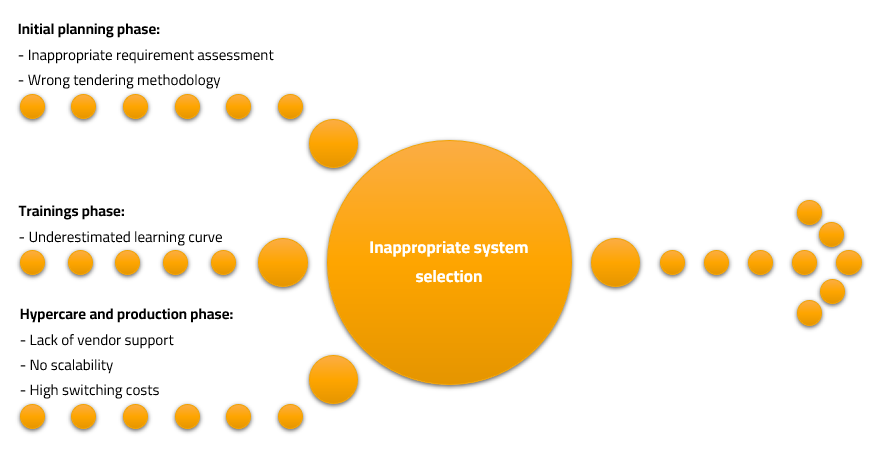
ERP system selection is a strategic and paramount decision point of the implementation project, as decision-makers choose a significant and long-term investment. The selection process involves multiple important steps while liaising with the software vendors. If the system selection process is defective, the enterprise is exposed to risks concerning successful adoption and usage. Inappropriate system selection might stem from multiple issues; in addition, it highly influences the result of the implementation:
In the initial planning phase of the project, inaccurate capture and assessment of requirements might cause false future processes; in this instance, the inappropriate selection would not reflect the real interest of the enterprise and employees. The tendering and selection process of the desired ERP system might be deficient, uncontrolled, and not benchmarked.
During the training planning and execution phase, the project team and managers might underestimate the complexity of the software if it is not aligned with expectations regarding the capabilities of human employees, workload, and timely go-live. Also, the onboarding of newcomers might slow down due to the length of the learning curve (Ruuse, 2020).
As the implementation project enters the production phase, the lack of vendor support might cause undesirable effects on the usage and adoption. If the enterprise is unable to solve technical issues or developments independently from the vendor, then the operative and progressive perspective of the system is damaged. Moreover, scalability and integration with other peripheral applications and systems are crucial for consideration in the selection process. Last but not least, high switching costs might cause barriers in the future if the ERP system and vendor are not selected carefully.
Stabilizing the root causes
The elimination of exposure to inappropriate system selection is a key element to increase the success rate of implementation projects. The following section will demonstrate mitigation and elimination techniques for the above-mentioned issues.
Requirement analysis in the initial planning phase is a momentous activity as future decisions will rely on the results of the collection, aggregation, and analysis. It is advised that the responsible business analysts research and familiarize themselves with the functions of ERP packages on the market to support the assessment and to unfold ”shadow” requirements. Radut and Codreanu (2012) argue that the tendering and selection process is the utmost important activity of the implementation project. In their concept, the aggregated requirements of the enterprise shall be controlled in an analytical criteria system. The criteria aspects shall be functionality, technology, expertise, flexibility, scalability, costs, implementation, and ease of use (Ranjan, Jha & Pal, 2016). Karsak and Özogul (2009) highlight that the system selection process shall be aided through the strategic criteria from the point of establishment to the alternative reduction point.
The system selection shall extend to the assessment of the complexity. During the training phase of the implementation, the project team shall provide and organize training for employees to increase commitment, build knowledge, and decrease resistance. The selection must ensure that the selected software provides a quick and adaptable learning curve (Martin & Adams, 2011).
Timely availability of vendor support and consultation at a reasonable cost level, scalability opportunities for future expansions are highlighted by many authors as a common ERP selection factor (Wei & Wang, 2005; Wei & Wang, 2004; Karsak & Özogul, 2009).
Summary in short
- Understanding and properly mapping the functional and technical requirements is a must to find a well-fitting software.
- Establishing a bulletproof system selection process can significantly reduce implementation efforts and increase end-user engagement.
- Prioritizing the most important criteria factors for selection, such as functional coverage, scalability of software, support of the Vendor, etc.
- Not underestimating the learning curve of the new software and the changed business processes.
- Shortlisting and demoing multiple Vendors to keep the competition in favor of the Client company.
ARE YOU READY to take your knowledge to a new level?
Review our End-To-End Masterclass
for comprehensive knowledge.
Start your journey today!
Bibliography
– Ruuse, L., 2020. 9 Reasons Why Your New Software Implementation Is Failing. [Online] Available at: https://www.scoro.com/blog/reasons-your-software-implementation-is-failing/ [Accessed 27 10 2020].
– Radut, C. & Codreanu, D.-E., 2012. Selection of an organization specific ERP system. Ideas REPEC Journal, 18(2), pp. 384-389.
– Ranjan, S., Jha, V. K. & Pal, P., 2016. Literature review on ERP implementation challenges. Int. J. Business Information Systems, 21(3), pp. 388-402.
– Karsak, E. E. & Özogul, C. O., 2009. An integrated decision making approach for ERP system selection. Expert systems with Applications, Volume 36, pp. 660-667.
– Martin, B. & Adams, B., 2011. Organizational Change Management Strategy. Washington Community and Technical Colleges ERP Project, pp. 1-10.
– Wei, C. C. & Wang, M. J. J., 2005. An AHP-based approach to ERP system selection. International Journal of Production Economics, 96(1), pp. 47-62.
– Wei, C. C. & Wang, M. J. J., 2004. A comprehensive framework for selecting an ERP system. International Journal of Project Management, Volume 22, pp. 161-169.