
Understanding the root causes
ERP software implementation projects imply high initial costs for large-sized enterprises, mainly for two reasons: Effort- and requirement-wise, the level of the project is extensive, moreover, large-sized enterprises can afford to invest a higher amount of funds in technological advancements than small- and medium-sized enterprises. As part of the intra-enterprise project preparation processes, budgeting has to be assessed even before the official project launch. It is highly challenging for the project team to frame exact procurement costs at this stage. Large-sized enterprise software projects tend to go through a tunnel, where costs are further defined and refined for more precision by the project team. During the tendering and procurement stages, the project team or the procurement department initiates the request for quote (RFQ) process. As a response, the software vendor submits the costs with the statement-of-work (SOW) document.
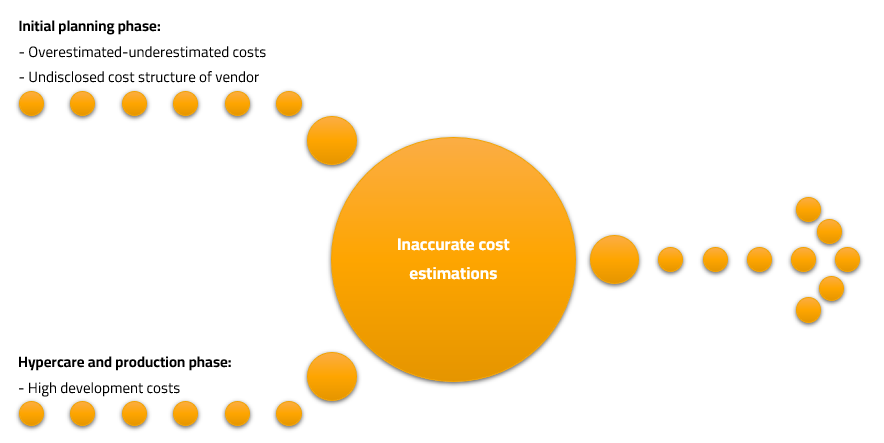
In the initial planning phase, the project team might face the issue of inaccurate cost estimations, as the requirements are not properly translated to the software vendor. In other scenarios, the software vendor might not determine the development costs explicitly and state a ‘from-to range’. It is likely that both of these result in an overestimation from the vendor’s perspective and an underestimation from the client’s perspective. Furthermore, the vendor might not reveal all aspects of the usage costs: it is not directly promoted by the vendor that certain ERP software has to be upgraded periodically to receive official support, and the upgrade has a significant cost.
In the long run, as the ERP software is in use, further enhancements or new functions need to be added to the existing and implemented system. The project team might not consider that such customization can require high capital for outsourcing it to the external software vendor or for internal technology experts.
Stabilizing the root causes
To overcome these barriers, the project team needs to ensure that enough emphasis is put on the requirement assessment. Each requirement shall receive a specification, business test case, and written description of the expected outcome to clarify any ambiguous points. Moreover, the project team and the procurement department have to arrange the contractual terms in a way that no cost overflow can occur and all the financial items are transparently determined. Besides the core software purchased, the usage might also incorporate licensing cost, maintenance cost, upgrade cost, and intellectual property cost as well. In addition, the enterprise shall estimate the future salary of the internal technical staff and the cost of switching to another ERP product as part of the total cost of ownership.
Cost estimations shall extend to the production phase of the implementation, likewise. Once the ERP system is adopted, the enterprise is likely to decide on adding new functions or launching other integration projects in connection with the ERP software. Estimation of such kind of development cost is indispensable.
Last but not least, ERP implementation projects might last for several months or years. Under the previously mentioned time span, contractual terms shall extend to adjustment as well. Adjustment to Consumer Price Index (CPI) or inflation is common; in such a scenario, when the vendor and the client use different currencies, then the foreign exchange rate shall be defined as well.
Summary in short
- Capturing initial requirements as detailed as possible to fix and frame the scope, hence the required costs.
- Refining cost estimations gradually as more and more information is available.
- Unfolding all cost elements (including hidden and unforeseen ones) of the software is crucial: the total cost of ownership needs to be assessed.
- Thinking long-term about cost estimations and considering the cost of enhancements in the future in case of platform-dependency.
- Calculating with price index adjustments or currency exchange rates due to the long span of such a project.
ARE YOU READY to take your knowledge to a new level?
Review our End-To-End Masterclass
for comprehensive knowledge.
Start your journey today!
Bibliography
– Landau, P., 2018. Statement of Work: Definition & Examples. [Online] Available at: https://www.projectmanager.com/blog/statement-work-definition-examples [Accessed 15 03 2021].